

Signs You Need to Modify or Replace Existing Ductwork
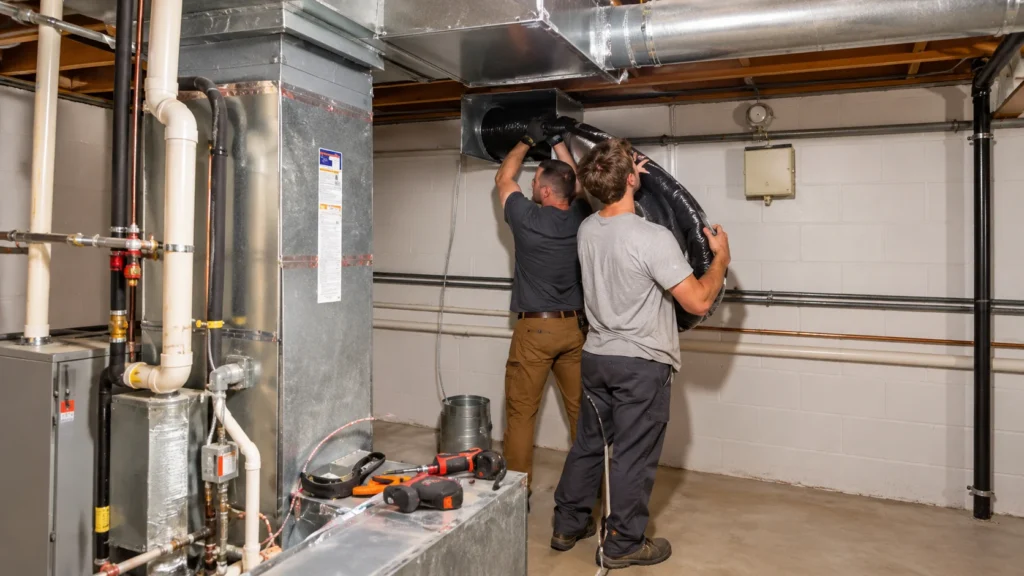
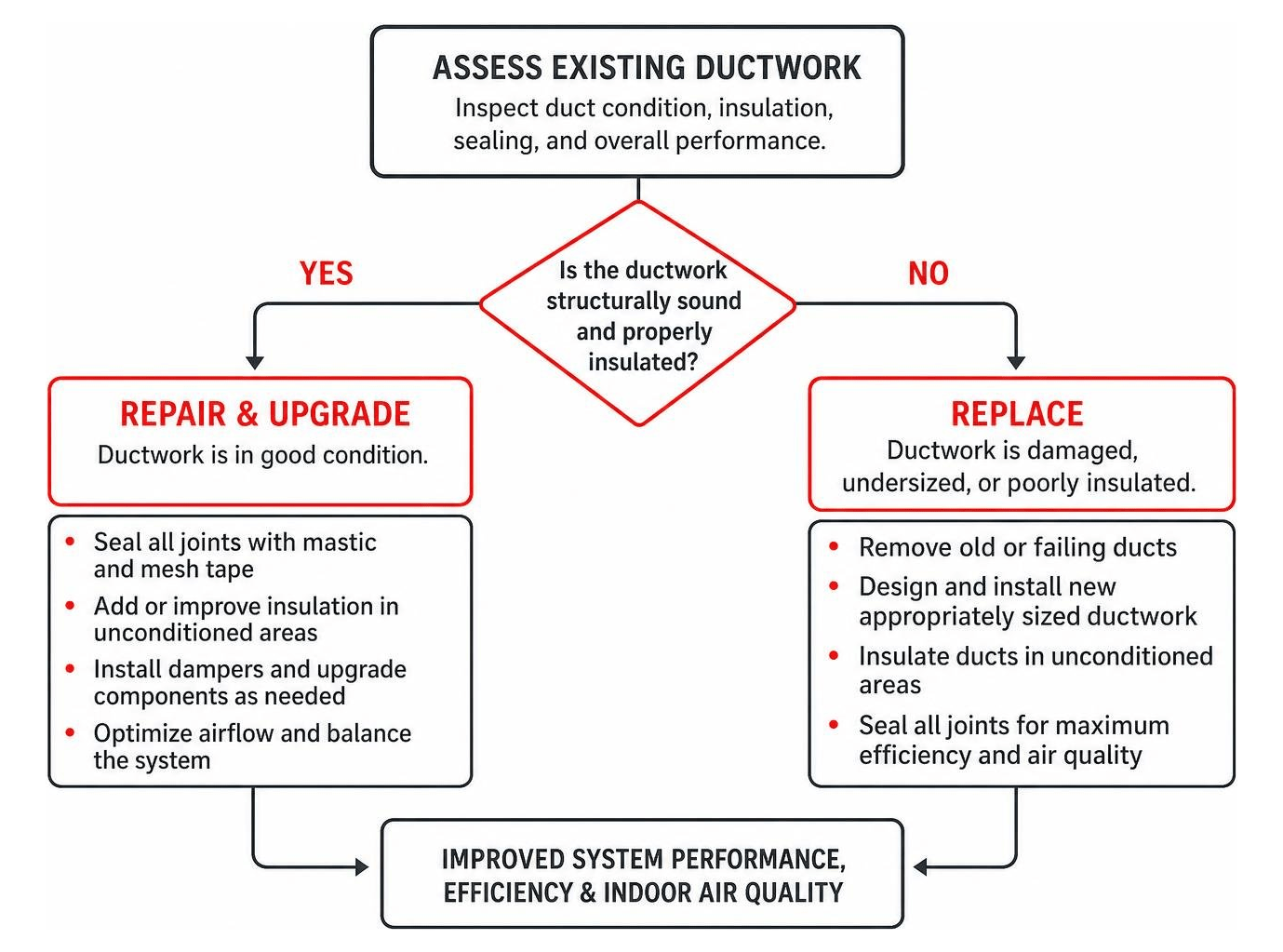
You may be able to reuse your ducts, but have them checked before the new furnace goes in. Ask your HVAC contractor to inspect for leaks, damage, and blocked runs, then measure airflow and static pressure against the new furnace’s requirements. If the ducts are sound but airflow is poor, sealing joints, enlarging a return, or changing a few fittings may be enough. Replace ducts that are badly damaged or cannot carry the airflow the system needs.
The experienced team at Aire-Flo Heating, Cooling & Generators helps homeowners plan ductwork updates that support safe, steady furnace performance. For a professional assessment, contact our team.

A brand-new heating unit is only as capable as the distribution network behind it. Connecting high-efficiency heating equipment to compromised ducting leads to poor comfort and elevated utility bills. When airflow cannot travel freely, you will often notice persistent temperature swings and hot and cold spots in your home.
Age, Physical Damage, and Airflow Restrictions
Duct networks experience continuous wear and tear over decades of heating cycles. Galvanized steel can rust or develop loose, vibrating joints, while older flexible runs often sag or kink. When ducts run through crawlspaces or unconditioned attics, pest intrusion or moisture can cause physical disconnections and biological growth. Leaky joints allow conditioned air to escape into wall cavities instead of reaching your living spaces. If your current distribution system has collapsed sections, crushed tubes, or extensive corrosion, modifications or partial replacements are necessary before commissioning new heating equipment.
Undersized Return Air and Inadequate CFM
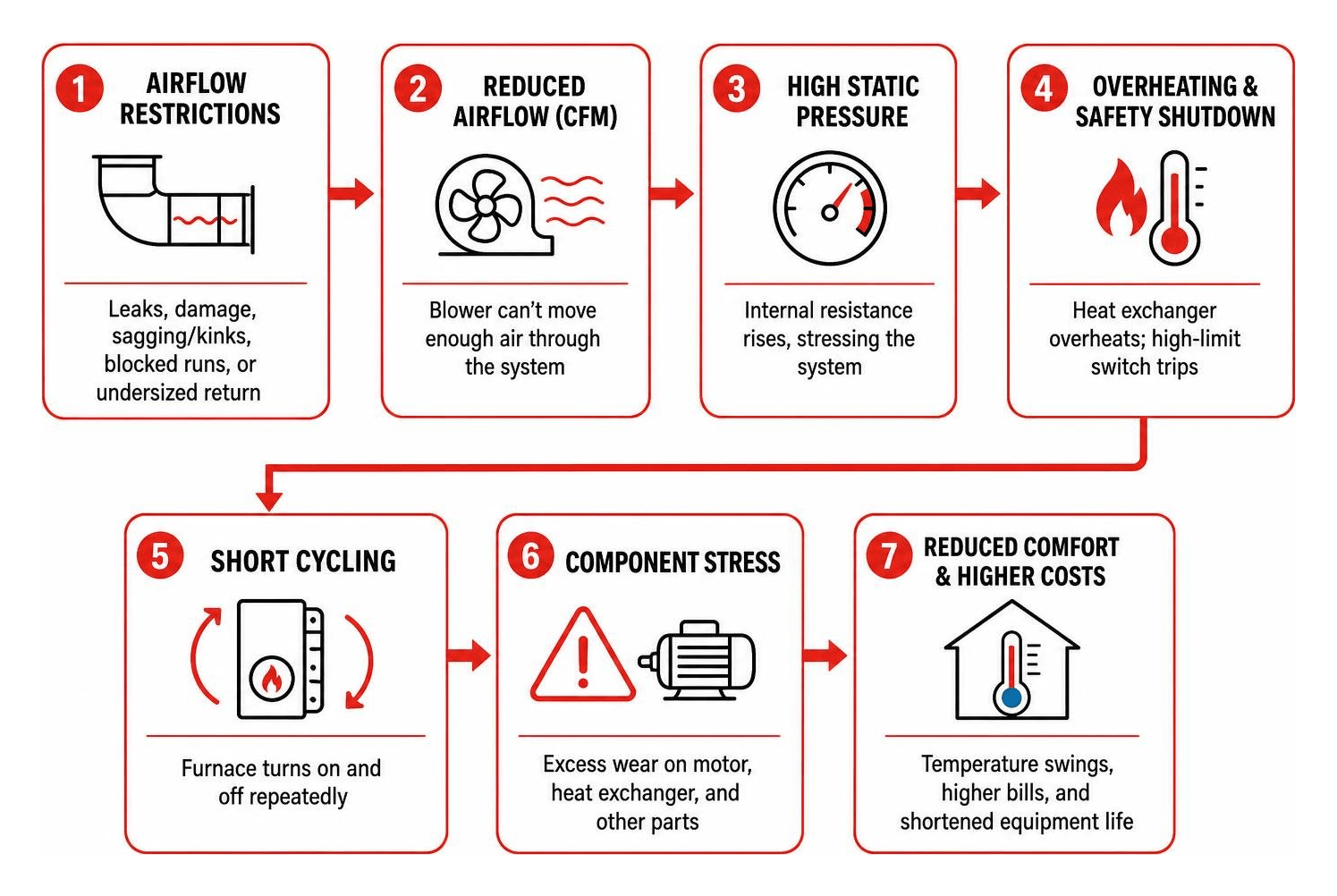
Furnaces require a balanced volume of circulating air to maintain safe internal temperatures. If your return grilles are too small or too few in number, the blower motor starves for air. This lack of cubic feet per minute (CFM) spikes the internal resistance of the system. Excessive static pressure overheats the heat exchanger, which causes high-limit switches to trip repeatedly. Homeowners dealing with this issue frequently struggle to solve furnace short cycling issues because the root problem sits inside the sheet metal rather than the furnace cabinet itself.
Planning Ductwork for New Furnace Install: Sizing and Airflow Dynamics
Modern heating equipment relies on precise airflow calculations. Sizing a layout requires more than matching the dimensions of the old furnace cabinet. Professional designs follow standards established by the Air Conditioning Contractors of America (ACCA) to guarantee that static pressure remains within safe operating thresholds.
Manual D Calculations and Static Pressure Management
The design process begins with ACCA Manual D protocols. This engineering calculation evaluates the friction rate, duct length, fitting losses, and total equivalent length across every supply and return branch. The goal is to keep total external static pressure (TESP) at or below design limits (typically 0.5 inches of water column).
When static pressure exceeds safe parameters, electronically commutated motors (ECM) must work harder to push air, leading to premature motor failure and noisy airflow. Following standardized equipment guidelines, such as those outlined in certified gas furnace installation manuals, ensures that duct static pressure matches the blower curve of your heating unit.
Balancing Supply Plenums and Return Drops
Proper airflow management requires smooth transitions at the furnace interface. The supply plenum sits directly atop or beside the furnace, directing heated air into the main supply trunks. If this transition fitting creates sharp angles, turbulence increases and static pressure climbs.
Equally important is the return drop. The return drop channels air from the return trunk down into the side or bottom of the furnace cabinet. Sizing the return drop to match the full CFM capacity of your system protects internal components and keeps blower speeds steady. Integrating manual volume dampers into each major supply branch gives our team the ability to balance airflow across every room in the house.
Choosing Materials: Flexible Ducts vs. Rigid Sheet Metal
Selecting the proper duct material affects air distribution, acoustics, and system lifespan. The table below compares the two primary duct materials used in residential systems:
| Feature | Rigid Galvanized Steel | Flexible Ductwork |
|---|---|---|
| Material Lifespan | 40 to 60 years | 15 to 25 years |
| Airflow Resistance | Low (Smooth interior) | Moderate to High (3x to 5x higher friction if slack) |
| Durability | High (Resistant to pests and tears) | Moderate (Vulnerable to punctures and crushing) |
| Best Application | Main trunks, plenums, return drops | Short branch runs, final connections |
| Installation Complexity | Requires custom fabrication | Faster installation in tight spaces |
Rigid Galvanized Steel vs. Flexible Ducting
Rigid galvanized steel provides a smooth interior surface that minimizes friction losses, allowing air to travel longer distances without losing velocity. It holds its structural shape indefinitely and will not crush or sag over time.
Flexible ducting consists of a wire helix wrapped in a polymer jacket and covered with fiberglass insulation. While flex duct is practical for navigating tight framing obstacles, it must be installed completely taut. When flex duct is installed with bends, sharp loops, or sagging runs, airflow resistance multiplies rapidly, starving distant registers of heat.
Insulation Standards and Thermal Efficiency
Any ductwork routed through unconditioned areas, such as unheated basements, attics, or crawlspaces, must be insulated. Uninsulated metal ducts lose significant heat to ambient air before delivering warmth to your living areas. Applying exterior fiberglass duct wrap with an appropriate R-value prevents thermal loss and eliminates condensation during cooling cycles. High thermal integrity ensures the heated air created by your furnace arrives in your living spaces at the intended temperature.
Critical Duct Modifications, Sealing, and Component Upgrades
Upgrading your air distribution system during equipment replacement provides an ideal opportunity to boost system efficiency and indoor air cleanliness.
Mastic Sealing and Leakage Reduction
Unsealed residential ducts can lose up to 30 percent of conditioned air into unheated spaces. Standard fabric or cloth-backed duct tape degrades and fails over time due to temperature fluctuations.
Our technicians at Aire-Flo Heating, Cooling & Generators use commercial-grade mastic paste reinforced with fiberglass mesh tape to seal every seam, elbow, and collar. Mastic cures into a flexible, permanent seal that stops conditioned air from leaking out and prevents dust or crawlspace fumes from entering your supply stream. Tightening the duct envelope protects equipment performance and helps improve indoor air quality throughout your home.
Key Modifications: Enhancing Ductwork for New Furnace Install Efficiency
During a new installation, several hardware updates help maximize efficiency:
- Aerodynamic Takeoff Collars: Replacing straight-angle takeoff fittings with radius or conical collars reduces turbulence as air exits the main trunk line.
- Dedicated Volume Dampers: Installing adjustable dampers in each supply run allows precise room-by-room balancing.
- High-Performance Filter Racks: Integrating a dedicated media air cleaner cabinet directly into the return drop prevents airflow restriction while capturing fine airborne particulates.
- Supply Registers and Grilles: Replacing stamped-face grilles with high-velocity, directional registers improves air mixing and eliminates drafts.
A professional furnace installation gives our team the opportunity to evaluate duct sizing, transitions, and airflow before our team commissions the new equipment.
Financial Breakdown: How Much Does New Ductwork Cost?
Investing in ductwork upgrades directly influences your monthly energy savings and the overall lifespan of your heating equipment. If you are planning an equipment upgrade, our detailed HVAC pricing breakdown outlines how system components and installation choices factor into overall project scopes.
Cost Factors for Ductwork for New Furnace Install Projects
Ductwork project scopes depend on the layout of your home, the location of the equipment, and the accessibility of existing runs. Key factors that determine the overall investment include:
- Home Size and Layout: Multi-story homes require longer vertical chases and specialized branch layouts, which involve more material and labor than single-story structures.
- Accessibility: Ducts located in open basements are much easier to modify than duct runs hidden inside finished ceilings or low-clearance crawlspaces.
- Material Selection: Complete sheet metal distribution networks carry higher initial fabrication requirements than hybrid systems using flexible runouts.
- Permits and Testing: Local code compliance, load calculations, and duct leakage testing ensure your distribution network meets rigorous efficiency targets.
Homeowners can review independent industry evaluations to understand how retrofits compare to new construction layouts.
Repair vs. Full Retrofit Return on Investment
A full distribution overhaul is not always required. When existing sheet metal trunks are properly sized and structurally sound, minor retrofits, such as enlarging a return drop, adding balancing dampers, and sealing joints with mastic, provide an outstanding return on investment.
These focused adjustments eliminate static pressure bottlenecks, lower electrical draw on blower motors, and extend the lifespan of your new furnace. Regular furnace maintenance can help our team catch airflow concerns before they put added strain on the system. However, if your existing ducts are severely undersized or extensively damaged, replacing them lowers utility costs and delivers consistent warmth to every room.
Frequently Asked Questions About Furnace Ductwork
Can I reuse old ductwork with a high-efficiency furnace?
Yes, you can often reuse existing ductwork if an inspection confirms it is clean, properly sealed, and appropriately sized for the airflow requirements of your new unit. Condensing high-efficiency furnaces produce steady, efficient airflow, but they rely on correct return dimensions to prevent heat buildup. Our technicians evaluate your existing sheet metal before installation to confirm compatibility.
What happens if ductwork is too small for a new furnace?
Undersized ducts restrict airflow, which increases static pressure within the system. This restriction traps excess heat inside the furnace cabinet, causing high-temperature limit switches to trip and cycling the furnace off prematurely. Over time, restricted airflow leads to cracked heat exchangers, burned-out blower motors, noisy supply vents, and uneven room temperatures.
How long does ductwork installation take during a furnace replacement?
Minor duct adjustments, such as building a new supply plenum, adjusting a return drop, and sealing accessible joints, are typically completed on the same day as the furnace installation. A complete ductwork replacement in an existing home generally takes two to three days, depending on attic or crawlspace accessibility and home design.
Conclusion
Installing a new heating system is a major step toward reliable winter comfort, but your furnace cannot deliver its rated efficiency without a sound, balanced distribution system. Evaluating static pressure, sizing supply and return trunks correctly, and sealing joints with mastic will protect your investment for decades to come.
At Aire-Flo Heating, Cooling & Generators, we bring 75 years of trusted experience to every project. For an airflow evaluation, system modifications, or ongoing support, contact our professional furnace and ductwork technicians to schedule a comprehensive assessment for your home.