

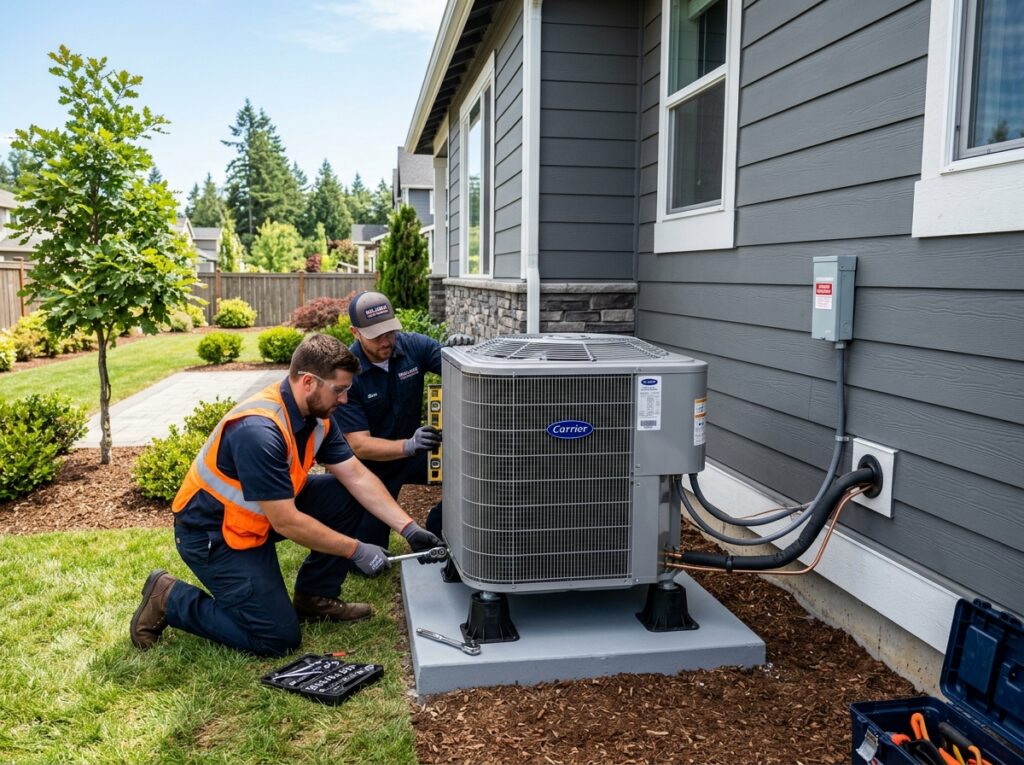
What You’ll Actually Pay for a New HVAC System in Columbus, OH
The cost for new HVAC system installed typically falls between $5,000 and $20,000 for most Columbus-area homes — with the average homeowner paying around $13,000–$14,000 for a complete system replacement.
Here’s a quick snapshot so you can budget before reading further:
| System Type | Typical Installed Cost |
|---|---|
| Central AC only | $3,500 – $9,000 |
| Gas furnace only | $3,800 – $12,000 |
| Full system (AC + furnace) | $10,000 – $20,000 |
| Heat pump system | $6,000 – $25,000 |
| Ductless mini-split | $2,000 – $14,500 |
A few things drive that wide range:
- Home size — bigger home means more tonnage, more cost
- System type and efficiency — higher SEER2 ratings cost more upfront
- Ductwork condition — replacing ducts can add $2,000–$5,000
- Labor and permits — typically 30–50% of the total bill
- Region — Columbus sits near the national average, but rates still vary by contractor
Replacing an HVAC system is one of the biggest home expenses you’ll face. Getting the numbers wrong — by undersizing, overpaying, or skipping rebates — can cost you thousands. This guide breaks it all down clearly.
I’m Steven Alexander, President and Co-Owner of Aire-Flo Heating, Cooling & Generators, and after decades of hands-on experience helping Columbus homeowners navigate the cost for new HVAC system installed, I’ve seen nearly every scenario — from straightforward swaps to complex full-system overhauls in aging homes. Let’s walk through what you actually need to know to budget this right.

Average Cost for New HVAC System Installed in 2026
When we look at Realistic Price Ranges for the upcoming year, the national average to replace a complete HVAC system is trending between $5,000 and $30,000. While that sounds like a massive gap, most of our neighbors in Dublin, Westerville, and Upper Arlington find themselves in the $11,000 to $16,000 range for a standard, high-quality replacement.
Why the variance? It usually comes down to the “Three Ls”: Labor, Load, and Luxury. Labor rates in the Columbus area are stable but reflect the high level of expertise required for modern, high-efficiency systems. Load refers to how much work the system has to do (home size), and Luxury refers to the equipment tier—whether you want a reliable “workhorse” system or a whisper-quiet, ultra-efficient “luxury” model.
Before you pull the trigger on a new system, you should identify the top signs for HVAC replacement. If your energy bills are spiking or you’re hearing “clunks” that sound like a dryer full of sneakers, your current unit is likely on its last legs.
In our region, installation complexity also plays a role. An HVAC unit tucked away in a tight crawlspace in Bexley will naturally cost more in labor than a unit easily accessible in a spacious Worthington basement.
Cost for New HVAC System Installed by Home Size
Size matters—but not in the way most people think. In the HVAC world, we don’t just look at square footage; we look at “tonnage.” Tonnage measures the system’s ability to cool your home. A “one-ton” AC unit can remove 12,000 BTUs of heat per hour.
Most homes in the Columbus area require between 2 and 5 tons of cooling capacity. To get this right, we perform a Manual J calculation. This isn’t just a guess based on your floor plan; it factors in your insulation, window types, and even which way your house faces.
| Home Size (Sq. Ft.) | Required Tonnage | Estimated Full System Cost |
|---|---|---|
| 1,000 – 1,500 | 2.0 – 2.5 Tons | $6,500 – $11,000 |
| 1,500 – 2,000 | 2.5 – 3.0 Tons | $8,500 – $14,000 |
| 2,000 – 2,500 | 3.5 – 4.0 Tons | $11,500 – $17,500 |
| 3,000+ | 5.0 Tons | $15,000 – $22,000+ |
If you undersize the system to save money, it will run constantly, skyrocket your bills, and die young. If you oversize it, it will “short cycle,” turning on and off so fast that it never removes the humidity, leaving you feeling clammy and uncomfortable.
Cost for New HVAC System Installed by Equipment Type
The type of “fuel” and technology you choose changes the cost of HVAC unit significantly.
- Central AC & Gas Furnace: This is the “Columbus Standard.” It combines a Furnace Installation for our snowy winters with a traditional AC Installation for our humid summers.
- Heat Pumps: These are becoming incredibly popular. A heat pump acts as an air conditioner in the summer and reverses itself to provide heat in the winter. Modern “cold-climate” heat pumps work great in Ohio and often qualify for the biggest tax credits. Expect to pay $6,000 to $25,000 depending on efficiency.
- Hybrid (Dual-Fuel) Systems: These pair an electric heat pump with a gas furnace. The heat pump handles the mild days, and the gas furnace kicks in when the temperature drops below freezing. It’s the best of both worlds for efficiency.
- Ductless Mini-Splits: Perfect for older homes in Bexley or additions that don’t have ductwork. These cost $2,000 to $14,500 depending on how many “heads” (indoor units) you need.
Key Factors Influencing Your Total Investment
When you receive a quote, the equipment is only about 50-60% of the price. The rest is the “invisible” stuff that makes the system actually work.
One of the biggest factors is the efficiency rating. For cooling, we look at SEER2 (Seasonal Energy Efficiency Ratio). The higher the number, the less electricity it uses. Since 2023, the federal minimum is 13.4, but many homeowners opt for 16 to 20 SEER2 to save on long-term costs. You can learn more about this in our guide on AC installation energy efficiency
For heating, we look at AFUE (Annual Fuel Utilization Efficiency). A 95% AFUE furnace means 95 cents of every dollar spent on gas goes directly into heating your home, with only 5 cents lost up the chimney.
Other factors include:
- Variable-Speed Compressors: These act like a dimmer switch rather than an on/off switch. They are quieter and keep temperatures more consistent but cost more upfront.
- Indoor Air Quality (IAQ): Adding whole-home humidifiers, UV lights, or high-efficiency air cleaners can add $500 to $3,000 to the total.
- Brand Reliability: While we service all brands, premium brands often offer better warranties and quieter operation.
The Impact of Ductwork and Infrastructure
Your HVAC system is like a heart, but the ductwork is the circulatory system. If the “arteries” are clogged or leaking, the heart has to work twice as hard.
According to industry data, poorly installed or aging ductwork can waste 25% to 40% of your system’s energy. If your ducts are undersized for a new, high-powered blower, they might whistle or rattle. Replacing ductwork for a 2,000 sq. ft. home typically adds $2,100 to $5,000 to the cost for new HVAC system installed.
Don’t forget the “boring” costs:
- Electrical Upgrades: A new high-efficiency heat pump might require a 200-amp service upgrade, costing $1,500 to $4,000.
- Permits and Inspections: In Columbus and surrounding suburbs, mechanical permits usually cost $50 to $500. Never let a contractor skip this—it’s your only proof the job was done to code.
- Disposal Fees: Safely hauling away and recycling your old unit (and its refrigerant) usually costs $60 to $500.
For a deeper dive into the setup process, check out our guide to AC installation for home.
Smart Strategies to Reduce Replacement Expenses
We know that a new HVAC system isn’t exactly a “fun” purchase like a new car or a kitchen remodel. However, there are ways to make the cost for new HVAC system installed much more manageable.
1. Time Your Purchase (The Shoulder Seasons) The busiest times for HVAC companies are the first heatwave of June and the first deep freeze of January. If you can, replace your system in the “shoulder seasons”—late spring (March/April) or fall (September/October). You’ll often find 5% to 15% discounts because demand is lower and our schedules are more flexible.
2. Leverage the Inflation Reduction Act (IRA) This is a game-changer. Under Section 25C, homeowners can claim federal tax credits for energy-efficient upgrades. You can get up to $2,000 per year for a qualifying heat pump or up to $600 for a high-efficiency central AC or furnace.
3. Utility Rebates Local utility companies in the Columbus area often offer “instant” rebates for switching to high-efficiency equipment. These can range from $200 to over $1,000. We always help our customers identify these before we start the project.
4. Financing Many people don’t have $14,000 sitting in a drawer. We offer various financing options, including 0% APR promotional periods. Just a heads-up: if you use 0% financing, make sure to pay it off before the promo ends, as interest rates can jump significantly afterward.
When HVAC replacement becomes the priority, looking at the benefits of new AC unit installation, like lower monthly bills and improved comfort, helps justify the investment.
Repair vs. Replace: The $5,000 Rule
One of the most common questions we get is: “Can’t you just fix it one more time?”
To help homeowners decide, we use the $5,000 Rule. You multiply the age of the unit by the cost of the repair. If the total is more than $5,000, you should replace it.
Example:
- Your AC is 12 years old.
- The repair (a new compressor) costs $600.
- 12 x 600 = $7,200.
- Verdict: Replace it.
If you’re still on the fence, ask yourself: do I need a new air conditioner? If your system still uses R-22 refrigerant (the “old” stuff), repairs will be astronomically expensive because R-22 is no longer manufactured.
We also see many people struggling with understanding the costs of furnace repair. If you see things like yellow flames instead of blue or frequent pilot light issues, it’s often a safety issue, not just a financial one.
Frequently Asked Questions about HVAC Costs
How long does a new HVAC system typically last?
A well-maintained central AC or furnace typically lasts 15 to 25 years. Heat pumps usually have a slightly shorter lifespan of 10 to 15 years because they work year-round (both heating and cooling). However, skipping annual maintenance can cut those numbers in half. Keep an eye out for signs you’re overdue for an HVAC replacement, like dust buildup or uneven temperatures between rooms.
What is the best time of year to replace my system?
As mentioned, the “shoulder seasons” of spring and fall are best. Not only are prices often lower, but you also won’t have to suffer through a 90-degree day without AC while the technicians are working. A standard replacement takes about one day, but a full install with new ductwork can take 3 to 5 days.
Are there tax credits available for high-efficiency units?
Yes! Through 2032, the federal government offers significant credits for Energy Star-rated equipment. The biggest “win” is the $2,000 credit for heat pumps. Central AC units and furnaces that meet specific efficiency tiers qualify for up to $600. Always check with your tax professional to ensure you meet the current IRS requirements.
Conclusion
At Aire-Flo Heating, Cooling & Generators, we’ve spent the last 75 years building trust in the Columbus area. We know that the cost for new HVAC system installed is a significant investment for your family. That’s why we don’t just “sell boxes”—we provide engineered comfort solutions tailored to your specific home.
Whether you’re in Dublin, Bexley, or right here in Columbus, we stand behind our work with a 100% satisfaction guarantee. We’ll perform a full Manual J load calculation to ensure your system is sized perfectly, and we’ll walk you through every available rebate to keep your costs as low as possible.
Ready to stop worrying about your old system and start enjoying a more comfortable, efficient home? Schedule your expert AC Installation today and let us show you why your neighbors have trusted us for three-quarters of a century.