

Why Your AC Running But Not Cooling Is More Common Than You Think
If your AC not cooling your home is the problem you’re dealing with right now, here are the most likely causes:
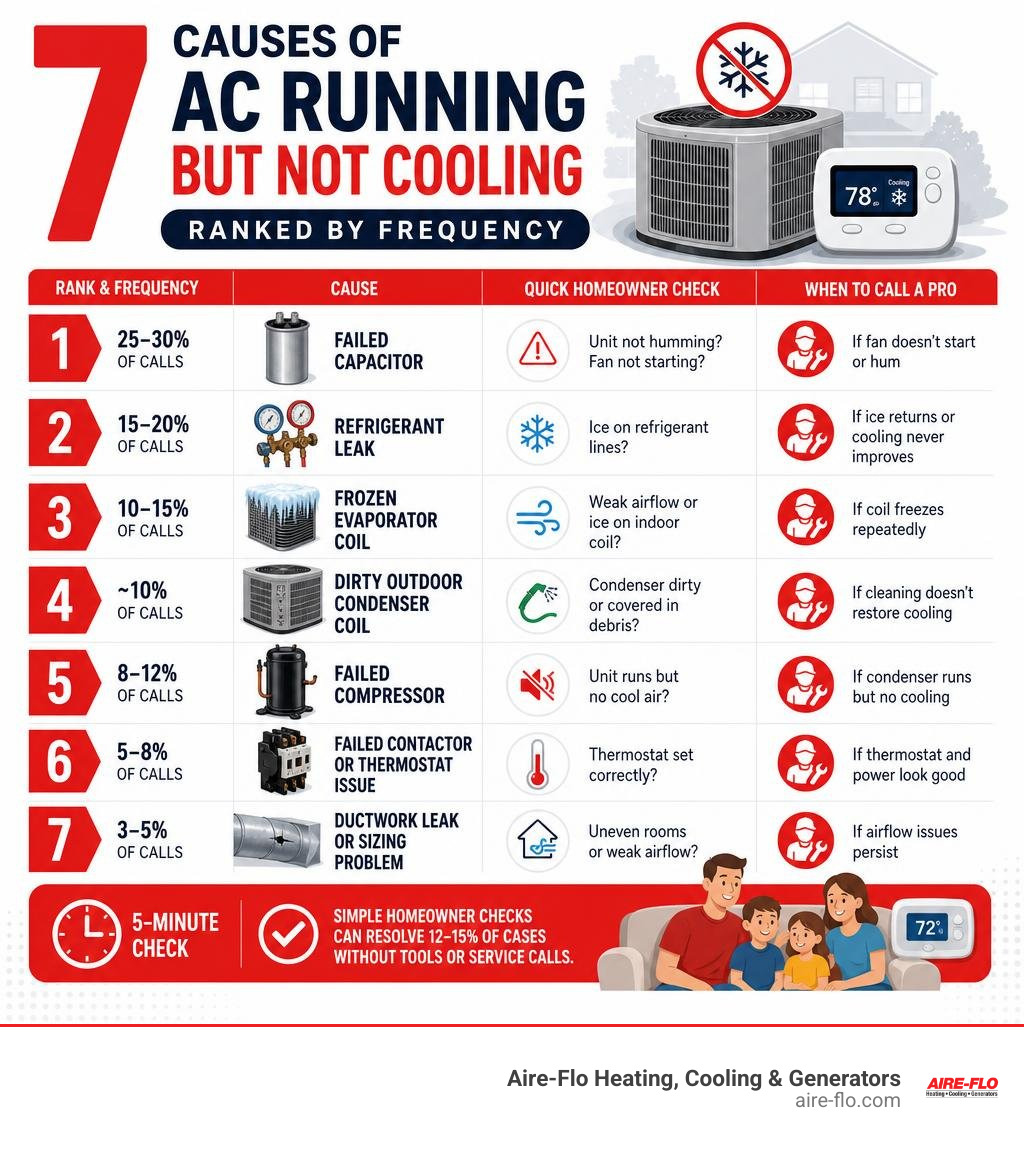
Quick Answer: 7 Reasons Your AC Runs But Won’t Cool
| Cause | How Common |
|---|---|
| Failed capacitor | 25-30% of calls |
| Refrigerant leak | 15-20% of calls |
| Frozen evaporator coil | 10-15% of calls |
| Dirty outdoor condenser coil | ~10% of calls |
| Failed compressor | 8-12% of calls |
| Failed contactor or thermostat issue | 5-8% of calls each |
| Ductwork leak or sizing problem | 3-5% of calls |
The good news? A simple 5-minute homeowner check resolves 12-15% of these cases without any tools or service calls.
Here is the frustrating reality: your AC sounds like it is working. The fan is blowing. The system kicks on. But an hour later, your Columbus home still feels like a sauna.
This happens because cooling and air movement are two separate functions. Your blower can run perfectly while the part of the system that actually removes heat has stopped working. The AC does not create cold air. It pulls heat out of your home and dumps it outside. When anything breaks that chain, you get warm air from the vents even though the unit is running.
Columbus summers push AC systems hard. When temperatures climb into the 90s, even a small problem that goes unnoticed in spring can turn into a full breakdown in July.
After decades of diagnosing AC not cooling problems across central Ohio, the team at Aire-Flo Heating, Cooling & Generators has found that most cases come down to a handful of predictable causes. Let’s walk through each one so you know exactly what you’re dealing with.
Troubleshooting Your AC Not Cooling: The 5-Minute Homeowner Check
Before you pick up the phone to schedule an AC repair, you should perform a quick diagnostic sweep. Many of our service calls in Columbus turn out to be simple power or safety switch issues. Doing this quick check can save you the cost of a diagnostic visit.
First, check your indoor air handler or furnace. Most modern systems feature a safety float switch installed in the condensate drain pan. If your drain line clogs with algae or debris, water backs up. The float switch rises and immediately cuts power to the outdoor condenser to prevent water damage. If you see standing water in your drain pan, vacuuming out the drain line with a wet-dry vacuum often restores your cooling immediately.
Second, check your electrical panel. Your air conditioner uses two separate breakers: one for the indoor blower fan and one for the outdoor condenser. If the outdoor breaker trips, your indoor fan will keep blowing warm air, but the outdoor unit will remain silent. Reset the breaker once. If it trips again, do not force it. A repeated trip indicates a serious electrical fault that requires professional attention.
Our team has compiled a guide on Solving Common AC Issues in Columbus to help you navigate these initial steps. Use the table below to run through your quick checklist.
| What to Check | What to Look For | Quick Solution |
|---|---|---|
| Thermostat | Mode set to “Heat” or Fan set to “On” | Switch mode to “Cool” and set Fan to “Auto” |
| Thermostat Batteries | Faded or blank screen | Replace with fresh AA or AAA batteries |
| Circuit Breaker | Tripped breaker in the main panel | Flip completely off, then back to the “On” position |
| Outdoor Disconnect | Pull-out switch or toggle in the outdoor box | Ensure the disconnect plug is firmly inserted |
| Float Switch | Standing water in the condensate pan | Clear the drain line with a wet-dry vacuum |
Thermostat Settings and Power Issues Causing Your AC Not Cooling
Your thermostat is the brain of your heating and cooling system. If it miscommunicates with your air conditioner, the entire cooling cycle breaks down.
A very common oversight is leaving the thermostat fan setting on “ON” instead of “AUTO.” When set to “ON,” the indoor blower fan runs continuously, even when the outdoor compressor is resting. This circulates unconditioned, humid air throughout your house, making you feel like your system is failing. Switching the fan setting to “AUTO” ensures the fan only blows when the system actively cools the air.
Dead or dying batteries can also cause a thermostat to lose calibration or fail to send the electrical signal to start the outdoor unit. Even if the display screen still looks active, weak batteries might not have enough power to close the internal relay that triggers the cooling cycle.
Airflow Obstructions That Stop Your Air Conditioner From Cooling
Air conditioning relies entirely on heat transfer. Your indoor evaporator coil absorbs heat from your household air, and your outdoor condenser coil releases that heat into the outside atmosphere. For this process to work, your system must maintain steady, unrestricted airflow.
When airflow drops, the system experiences high static pressure. This means the blower fan works much harder to push air through a restriction, which chokes the system. Without enough warm air passing over the cold evaporator coil, the refrigerant inside cannot absorb heat properly. This ruins your system’s efficiency and eventually causes a total cooling failure.
To prevent these issues, clean or replace your air filters every 30 to 90 days. Regular maintenance keeps your system running smoothly and helps you beat the heat by identifying signs your air conditioner needs repair.
Clogged Air Filters and Blocked Vents
A dirty air filter is the most frequent reason an air conditioner stops cooling. When a filter fills with dust, pet dander, and hair, it acts like a solid wall. The blower fan cannot pull enough air through the return grilles.
This lack of airflow causes a chain reaction. The cold refrigerant inside the evaporator coil has no heat to absorb, causing the coil temperature to plunge below freezing.
Additionally, many homeowners block their own airflow by closing supply registers or placing furniture in front of return grilles. Some believe closing vents in unused rooms saves energy, but modern central AC systems are designed for a specific volume of air. Closing vents creates back-pressure, reduces system efficiency, and can actually damage your blower motor. Keep all vents and returns completely open to maintain proper system balance.
Frozen Evaporator Coils
When airflow is restricted, your indoor evaporator coil will freeze. This issue accounts for 10-15% of all emergency cooling calls.
Once ice begins to form on the copper tubing, it acts as an insulator. The ice prevents the remaining airflow from contacting the refrigerant, causing the coil to freeze even faster until it becomes a solid block of ice.
If you notice weak airflow, a complete lack of cooling, or water pooling around your indoor furnace unit, your coil is likely frozen. Running your system in this state can destroy your compressor.
Turn the system off immediately at the thermostat and switch the fan setting to “ON.” This allows your household air to slowly melt the ice over several hours. Do not turn the cooling back on until the ice melts completely and you replace your dirty air filter. A frozen coil also prevents your system from dehumidifying your home, which is explained further in this article on Why Your AC Isn’t Removing Humidity.
Dirty Outdoor Condenser Coils
Your outdoor condenser unit has a big job: it must dump all the heat gathered from inside your home into the hot outdoor air. If the thin aluminum fins on the outdoor unit are caked with dirt, lawn clippings, cottonwood seeds, or leaves, the heat gets trapped inside the system. Dirty outdoor coils account for roughly 10% of all AC not cooling service calls.
To prevent this, maintain a clear 2-foot perimeter around your outdoor unit. Cut back shrubs, weeds, and overhanging branches.
You can clean the condenser coils yourself by turning off the power at the outdoor disconnect box and gently rinsing the unit with a garden hose. Spray at a 45-degree downward angle to wash away debris. Never use a pressure washer, as the high-pressure stream will bend the soft aluminum fins and permanently block airflow.
Mechanical and Electrical Failures in Your AC System
When your air conditioner runs but fails to cool, the problem often lies within the complex electrical and mechanical components housed inside the outdoor cabinet. These components handle high-voltage electricity and operate under extreme pressures.
Because of the high risk of electrical shock and system damage, homeowners should never open electrical panels or service these parts. Diagnosing them requires specialized tools, multimeters, and professional expertise, which is why routine AC Maintenance is so important.
Understanding these failures can help you identify what is happening before you call our team. For a deeper look at these issues, read about what causes AC breakdowns in Delaware.
Low Refrigerant and Leaks: Why Your AC Not Cooling is a Warning Sign
Refrigerant is the lifeblood of your air conditioner. It continuously cycles between liquid and gas states to carry heat out of your home.
A common misconception is that air conditioners consume refrigerant over time. In reality, your AC is a sealed system. If your refrigerant level is low, you have a leak. Refrigerant leaks account for 15-20% of all cooling failure calls.
Operating an air conditioner with low refrigerant causes the system to run constantly, raises your energy bills, and prevents proper cooling. More importantly, it deprives the compressor of the cool gas it needs to stay lubricated and cool, which can cause permanent compressor failure.
Signs of a leak include a bubbling or hissing sound from the copper lines, ice forming on the outdoor refrigerant lines, or an AC that only cools your home on mild days. Because refrigerant handling requires EPA Section 608 certification, only a licensed technician can legally locate, repair, and recharge the system.
Failed Capacitors and Contactors
Your outdoor unit relies on two small but critical electrical components: the capacitor and the contactor.
The capacitor acts like a temporary battery, storing electrical energy to provide the high-voltage boost needed to start and run the compressor and outdoor fan motor. Extreme summer heat in Ohio degrades these components quickly. Capacitor failure is incredibly common, accounting for 25-30% of all summer emergency service calls.
If your capacitor fails, you may hear a loud humming or clicking noise from the outdoor unit, but the fan and compressor will not start.
The contactor is a heavy-duty electrical switch that closes when the thermostat calls for cooling, sending power to the compressor and fan. Over time, the silver contacts inside can pit, burn, or get stuck together.
If a contactor fails, the outdoor unit may run continuously even when the thermostat is turned off, or it may fail to turn on at all. Replacing these high-voltage parts requires professional tools and safety training.
Failed Compressor
Often called the heart of the air conditioning system, the compressor pumps refrigerant through the indoor and outdoor coils. If the compressor fails, the refrigeration cycle stops completely. Your indoor fan will continue to blow warm air, but no heat transfer will occur. Compressor failures account for 8-12% of central AC cooling issues.
Compressors usually fail due to underlying, unresolved issues, such as running with a dirty filter for years, ignoring a refrigerant leak, or failing to address a bad capacitor.
Signs of a failing compressor include loud clanging or rattling noises during startup, frequent short cycling, or a breaker that trips the instant the cooling cycle begins.
Because the compressor is the most expensive component in your air conditioner, a failure on a system older than 10 years usually means it is time to replace the entire outdoor unit rather than paying for a costly repair.
Ductwork Problems and System Sizing Issues
Sometimes, your air conditioner and thermostat work perfectly, but the cooled air never actually reaches your living spaces. This problem points to issues within your home’s ductwork or an incorrectly sized system.
If your ducts are damaged, or if your air conditioner was not sized correctly for your home’s square footage, you will struggle with uneven temperatures and high energy bills.
Before assuming your AC is broken, it is wise to evaluate your duct system and overall equipment capacity. Learn more about these systemic issues by reading Is Your AC Truly Ready for Summer? Signs You Need Air Conditioning Repair Now.
Leaky or Disconnected Ducts
According to the Department of Energy, the average home loses 20% to 30% of its conditioned air through leaks, gaps, and poor connections in the ductwork. If your ducts run through an unconditioned attic or crawlspace and a joint disconnects, you are paying to cool the outdoors while your home stays warm.
Leaky ducts create an imbalance in air pressure. This pulls hot, dusty attic air directly into your living spaces and causes uneven cooling, where some rooms feel ice-cold while others remain stuffy.
If you notice a sudden drop in airflow from specific vents, or if your energy bills spike without a change in weather, a professional duct inspection and sealing service can restore your home’s comfort and efficiency.
Undersized or Oversized AC Units
An air conditioner must be sized precisely for your home using a professional Manual J load calculation. This calculation takes into account your home’s square footage, insulation levels, window placement, and local climate.
If your system is undersized, it will run continuously during hot summer days but will never quite reach your set temperature. This is especially common after homeowners build home additions or finished basements without upgrading their HVAC system.
Conversely, an oversized system is also a major problem. An oversized AC cools your home too quickly and shuts off before completing a full cycle. This is called short cycling.
Because the system does not run long enough, it fails to remove humidity from the air. This leaves your home feeling cold and clammy.
During extreme heat waves, even a perfectly sized system may sit 2 to 5 degrees above your set temperature during the hottest afternoon hours. This is normal, but if your system consistently struggles on average summer days, it may be sized incorrectly.
Frequently Asked Questions About Air Conditioner Performance
Should I turn off my AC if it is running but not cooling?
Yes, you should turn your air conditioner off immediately if it runs but fails to cool your home. Continuing to run a malfunctioning AC puts immense strain on the compressor.
If the problem is a refrigerant leak or a frozen coil, running the system can cause the compressor to overheat and fail permanently, turning a minor repair into an expensive replacement.
Additionally, turning the system off allows any accumulated ice on your evaporator coil to melt safely before a technician arrives.
How long does it take for an AC to start blowing cold air?
A properly functioning central air conditioner should begin blowing noticeably cold air from your supply vents within 5 to 15 minutes of starting up.
To verify your system’s performance, you can perform a simple temperature split test. Use a standard thermometer to measure the temperature of the air entering your return grille, and then measure the temperature of the air coming out of a nearby supply vent.
A healthy system should show a temperature split of 15 to 20 degrees. If the difference is less than 15 degrees, your system is not cooling efficiently.
Can a dirty air filter cause the AC to stop cooling?
Yes, a dirty air filter is the single most common cause of cooling failures. A clogged filter restricts airflow through the indoor unit, which lowers the temperature of the evaporator coil.
This lack of airflow causes the moisture on the coil to freeze, creating a physical barrier of ice that completely blocks heat transfer.
The restricted airflow also strains your blower motor and can cause the compressor to overheat, leading to a complete system shutdown.
Conclusion
A cooling breakdown in the middle of a hot Ohio summer is a major disruption to your comfort and peace of mind. While simple issues like a dirty filter or a tripped breaker can be resolved quickly at home, most mechanical and electrical failures require professional diagnostic tools and training.
If you live in Blacklick, Canal Winchester, Columbus, Delaware, Dublin, Galena, Galloway, Grove City, Hilliard, Marysville, New Albany, Pataskala, Pickerington, Plain City, Upper Arlington, or Worthington, our team is here to help.
At Aire-Flo Heating, Cooling & Generators, we have provided trusted, top-rated service to the Columbus, Ohio area for 75 years. We stand behind our work with a 100% satisfaction guarantee.
The best way to prevent unexpected cooling failures is to schedule a professional tune-up every spring. Regular maintenance keeps your system efficient, lowers your energy bills, and catches minor component wear before it turns into a hot-weather emergency.
To keep your home comfortable all summer long, you can stay ahead of repairs with AC maintenance or schedule your AC repair by contacting our experienced team today.