

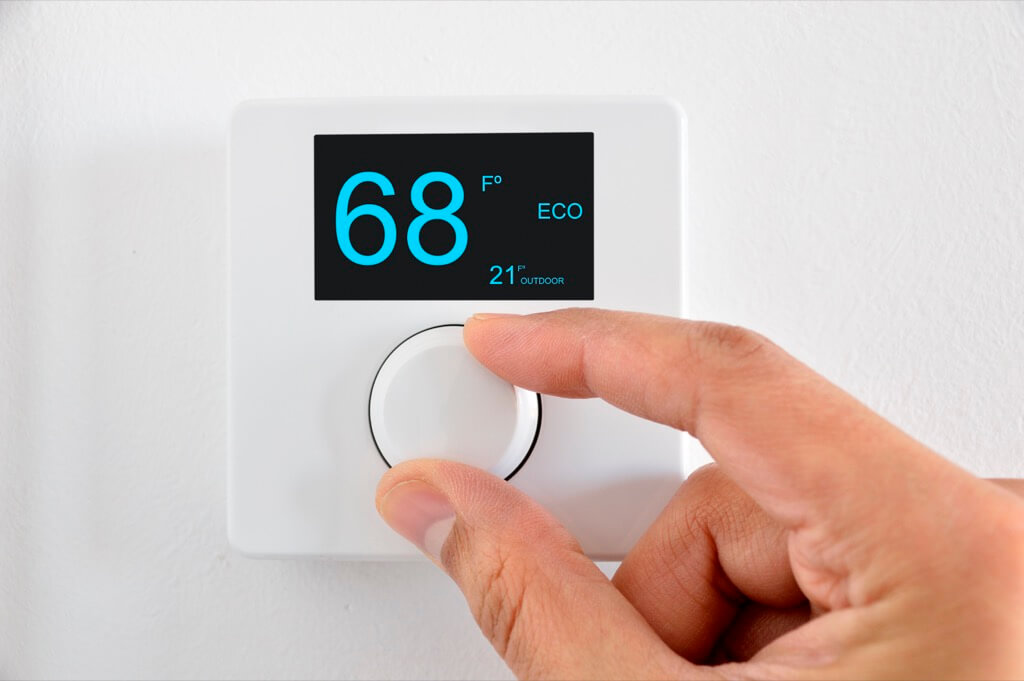
Is It Your Thermostat or Your AC? Here’s How to Know
AC thermostat problems are behind roughly 30% of all “AC not cooling” service calls, yet most homeowners assume the worst and fear a costly system repair. Before you go down that road, it is worth knowing that the fix is often much simpler than you think.
Here are the most common AC thermostat problems and what they usually mean:
| Problem | Most Likely Cause |
|---|---|
| Blank thermostat screen | Dead batteries or tripped breaker |
| AC won’t turn on | Wrong mode setting or failed thermostat signal |
| Room never reaches set temperature | Sensor drift or dirty thermostat |
| AC turns on and off rapidly | Short cycling from thermostat or filter issue |
| AC runs nonstop | Stuck relay or calibration error |
| Temperature reads incorrectly | Sensor failure or poor thermostat placement |
Your thermostat is the brain of your entire HVAC system. It reads your home’s temperature, compares it to your set point, and sends a signal to your AC to start or stop. When that communication breaks down, your AC can behave in ways that look like a serious mechanical failure, even when the AC itself is perfectly fine.
The good news: many thermostat issues are diagnosable in minutes, and a surprising number are fixed with a fresh set of batteries or a quick setting change.
Our team at Aire-Flo Heating, Cooling & Generators has led HVAC service in Columbus, OH, for decades. We have seen AC thermostat problems misdiagnosed as compressor failures, refrigerant leaks, and major electrical faults more times than we can count. In this guide, we will walk you through exactly how to tell the difference, so you know what you are dealing with before spending a dime on repairs.
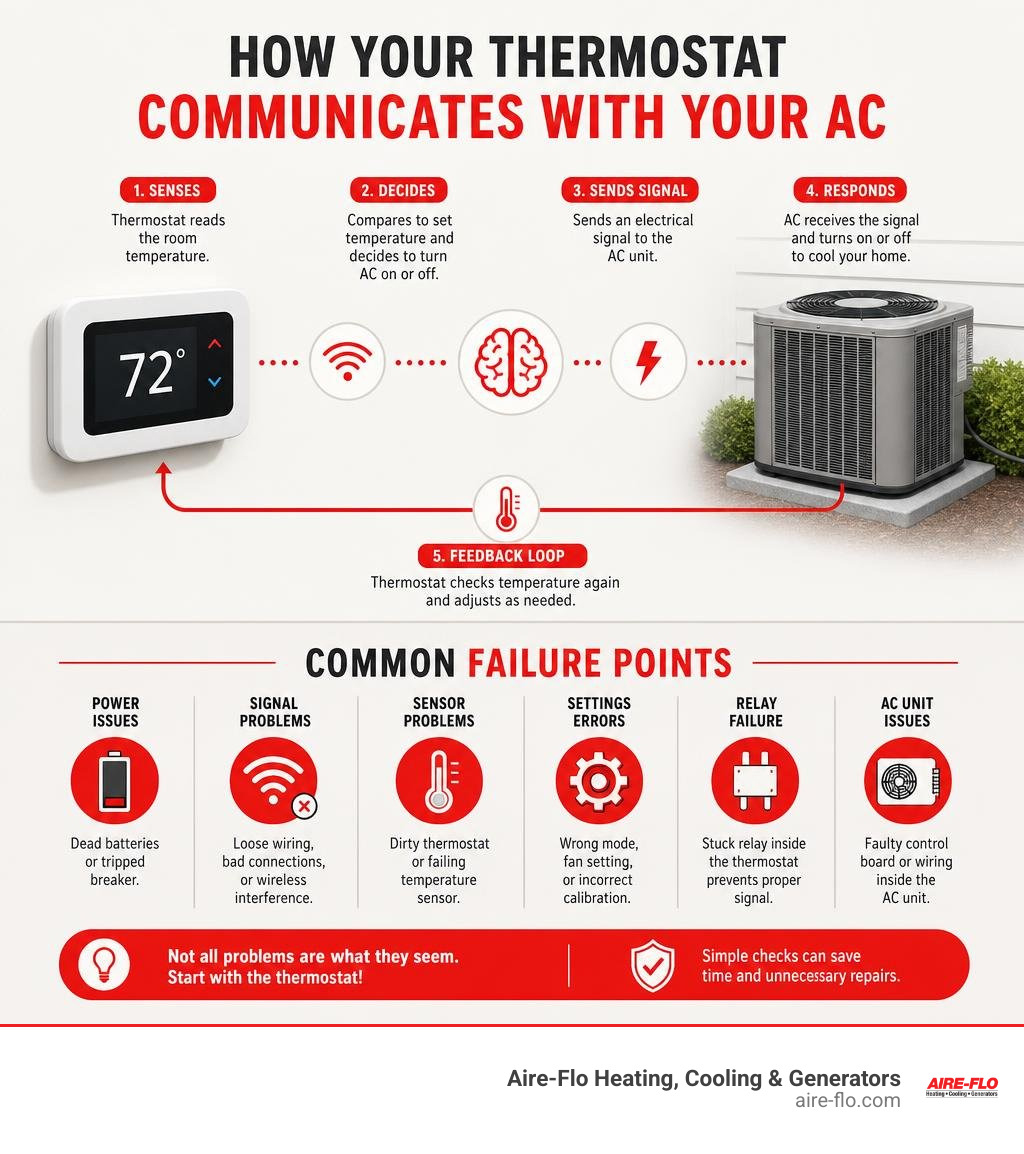
Common AC Thermostat Problems That Mimic System Failure
When your home starts warming up, your first instinct is to worry about a broken air conditioner. However, a failing thermostat often produces the exact same symptoms as a dead AC.
A completely blank screen is one of the most common issues we see. If your thermostat screen is dark, it cannot send the low-voltage signal to your furnace, air handler, or outdoor condenser. This issue often traces back to dead batteries. Many digital thermostats rely on AA or AAA batteries to retain their programming and power the display. When these batteries die, the entire cooling system shuts down.
Incorrect settings also cause major headaches. Sometimes, a family member accidentally switches the system to “Heat” or “Fan Only” mode. Other times, a smart thermostat might trigger an “Eco” or “Away” mode unexpectedly. Before assuming your cooling system is broken, check the thermostat’s mode, schedule, and temperature set point to rule out simple programming mistakes.
Sensor drift is another subtle problem. Over time, the internal temperature sensor in your thermostat can lose its accuracy. If the sensor drifts by even a few degrees, the thermostat will believe your home is cooler than it actually is, preventing the cooling cycle from starting.
Physical issues like loose wiring and dirt buildup also mimic system failures. Dust, pet hair, and nicotine residue can coat the electrical contacts inside older mechanical and digital thermostats. This grime insulates the contacts, blocking the signals that tell your AC to run. Additionally, loose wire connections behind the mounting plate can cause intermittent power loss, which may leave the AC running but not cooling properly.
How to Tell If the Thermostat or the AC Unit Is Faulty
To avoid paying for unnecessary repairs, you must learn to separate thermostat issues from mechanical AC failures. If the problem lies within the outdoor unit, you are likely dealing with a bad capacitor, a faulty contactor, or low refrigerant.
A run capacitor acts like a temporary battery that helps the compressor and outdoor fan motor start and run. When a capacitor fails, you might hear a humming sound from the outdoor unit, but the fan and compressor will not spin. A faulty contactor, which is the electrical switch inside the condenser, can also prevent power from reaching the compressor.
Refrigerant leaks are another major mechanical issue. If your system is low on refrigerant, the AC will run continuously but only blow warm air. You might also notice ice forming on the copper lines or the indoor evaporator coil.
When these mechanical parts fail, they often cause AC short cycling, which is when the compressor turns on and off rapidly. This behavior ruins your energy efficiency and places immense strain on your equipment. In severe cases, electrical shorts in the compressor or fan motor will end up tripping the breaker, shutting down the power to protect your home.
Identifying AC Thermostat Problems vs. Mechanical Failures
You can often identify the culprit by paying close attention to how the system behaves.
- Fan runs, but no cold air: If you set your thermostat to “Cool” and the indoor fan blows warm air while the outdoor unit remains completely silent, the thermostat might have a failed internal cooling relay.
- Continuous running: If the indoor temperature is well below your thermostat setting but the AC refuses to shut off, the thermostat may have a stuck relay or a severe calibration error.
- Short cycling: If the AC shuts down after only two or three minutes, the thermostat might be located in a drafty area, near a hot window, or directly under an air vent, causing it to read rapid, artificial temperature swings.
- Temperature mismatch: When your wall thermostat reads 72 degrees but your home feels like 78 degrees, you can verify the discrepancy by taping a separate thermometer next to the thermostat for twenty minutes.
If you live in Central Ohio, diagnosing these issues quickly prevents minor glitches from turning into expensive repairs. Homeowners dealing with weak airflow, warm vents, or repeated shutdowns can schedule local AC repair in Columbus, OH to have the thermostat, wiring, and cooling equipment checked together.
Columbus-area weather can also make thermostat and AC issues harder to separate because heat, humidity, and heavy system use put extra strain on older components. If your symptoms appear during a summer temperature swing, our breakdown of common AC issues in Columbus explains how local conditions affect cooling performance.
The Definitive Bypass Wire Test
If you want to prove whether the thermostat is the problem, you can perform a bypass wire test. This test bypasses the thermostat entirely and sends a direct signal to the indoor air handler or furnace.
Most residential systems use a 24-volt low-voltage control circuit. The red wire (R) carries the power, while the yellow wire (Y) controls the cooling signal.

To perform this test:
- Turn off the power to your indoor furnace or air handler at your circuit breaker panel.
- Remove the thermostat faceplate from the wall to expose the wiring terminals.
- Locate the R (or Rc) terminal and the Y terminal.
- Use a small piece of insulated copper jumper wire to connect the R terminal directly to the Y terminal.
- Turn the circuit breaker back on.
If your outdoor condenser and indoor fan turn on immediately, your thermostat is faulty, miscalibrated, or not receiving power. If the system still does not turn on, the problem lies within your furnace control board, the outdoor unit, or the wiring between them.
Always use caution during this test. Never touch high-voltage wires, and do not leave the jumper wire in place for more than a couple of minutes, as this bypasses all system safety controls.
Step-by-Step DIY Troubleshooting for Thermostat Issues
Before calling a professional technician, try these simple step-by-step troubleshooting steps. They resolve the vast majority of common thermostat issues.
- Replace the batteries: Pop off the thermostat cover and install a fresh set of high-quality alkaline batteries. Avoid rechargeable batteries, as they often do not provide consistent voltage.
- Reset the circuit breaker: Go to your home’s main electrical panel. Locate the breakers labeled “AC,” “Furnace,” or “HVAC.” Flip them completely to the “Off” position, wait thirty seconds, and flip them back to “On.”
- Clean the thermostat interior: Dust and debris block electrical signals. Remove the cover and use a soft brush or a can of compressed air to blow away any dirt from the copper coils, contact points, and circuit board.
- Unlock the screen: Many modern thermostats have a lock feature to prevent accidental setting changes. If your screen is stuck on one temperature, try pressing the plus (+) and minus (-) keys simultaneously for five seconds to unlock it.
- Verify the mode and setpoint: Ensure the system is set to “Cool” and the target temperature is at least five degrees below the current room temperature.
Even if a thermostat fix gets your cooling system running again, recurring symptoms may point to a maintenance issue elsewhere in the system. A seasonal AC maintenance service visit can catch dirty coils, weak electrical parts, and airflow problems before they start looking like thermostat failures.
Understanding the difference between quick DIY fixes and professional maintenance is key to protecting your HVAC system. For Dublin homeowners deciding whether a service call is urgent, this comparison of AC repair vs. maintenance explains when a cooling problem needs repair work and when routine upkeep is enough.
Repairing vs. Replacing Your Thermostat
If your troubleshooting efforts do not work, you must decide whether to repair or replace your thermostat. In almost all cases, replacing a faulty digital or smart thermostat is the smartest and most cost-effective choice.
| Thermostat Type | Average Lifespan | Best Action for Failures | Key Consideration |
|---|---|---|---|
| Analog (Mercury) | 20 to 35 years | Replace immediately | Inefficient and contains hazardous mercury |
| Basic Digital | 10 years | Replace | Low replacement cost, simple operation |
| Smart / Wi-Fi | 5 to 10 years | Replace or update firmware | Requires a C-wire and strong Wi-Fi signal |
While old analog thermostats can last for decades, they lack the precision of modern electronic sensors. If you have an old mercury dial thermostat, we recommend replacing it immediately to improve your home’s comfort and lower your energy bills.
When choosing a replacement, check your system’s compatibility. Smart thermostats usually require a common wire (C-wire) to provide continuous 24-volt power for their Wi-Fi radios and color screens. If your older home lacks a C-wire, you may need a professional to run new thermostat wiring or install a power-adapter kit.
When to Upgrade to Prevent Future AC Thermostat Problems
Upgrading to a modern programmable or smart thermostat does more than just solve your current cooling issues. It protects your entire HVAC system from unnecessary wear and tear.
Smart thermostats use advanced algorithms to prevent short cycling, ensuring your compressor runs for optimal, efficient cycles. They also allow you to set precise schedules, reducing system runtimes when you are away at work or sleeping. This reduced workload extends the lifespan of your air conditioner and lowers your monthly utility bills.
To keep your system running reliably year-round, combine your thermostat upgrade with regular system checkups. Preventive care helps your technician confirm that thermostat settings, AC wiring, airflow, and refrigerant performance are all working together correctly.
Frequently Asked Questions About Thermostat and AC Issues
Why is my thermostat screen blank even after changing the batteries?
If fresh batteries do not bring your thermostat back to life, the system has likely lost its 24-volt power supply from the indoor air handler or furnace. This issue usually points to a tripped circuit breaker or a blown low-voltage fuse on the furnace control board.
Another common cause is a clogged condensate drain line. When water backs up in your AC drain pan, a safety float switch trips and cuts power to the thermostat to prevent water damage to your home.
Can a bad thermostat cause my AC to run constantly?
Yes. If your thermostat’s temperature sensor loses its calibration, it may continuously read the room temperature as hotter than it actually is. This causes the thermostat to send a continuous cooling signal to your air conditioner.
A wiring short behind the wall or a stuck internal cooling relay can also keep the 24-volt cooling circuit closed, forcing your AC to run nonstop until you shut off the power at the breaker panel.
How do I know if my AC is low on refrigerant or if the thermostat is broken?
If your AC is low on refrigerant, you will hear the outdoor unit running and feel warm air blowing from your indoor supply vents. You may also notice ice forming on the copper refrigerant lines or find a frozen indoor evaporator coil.
If the thermostat is broken, the outdoor unit will typically not turn on at all, or the indoor fan will run without any signal going to the outdoor condenser. A professional technician must use a manifold gauge set to measure the exact refrigerant pressures and locate any leaks.
Conclusion
Diagnosing AC thermostat problems before assuming your air conditioner has failed can save you time, stress, and unnecessary repair costs. By checking the batteries, verifying your settings, and performing simple DIY checks, you can resolve many common issues on your own.
However, if your thermostat has failed completely, or if you are dealing with complex wiring, multi-stage systems, or smart thermostat compatibility issues, it is always best to bring in professional support.
For 75 years, Aire-Flo Heating, Cooling & Generators has provided trusted, top-rated HVAC services with a 100% satisfaction guarantee across the Columbus, OH area, including Dublin, Delaware, Galloway, and Grove City. If you need help resolving a stubborn cooling issue or want to upgrade to a smart thermostat, contact our professional AC repair technicians today to schedule your service.